
Drawing Lines
Fractionally Legal v. 48 Looks at Where we Draw the Lines, Literally

First, a correction from the last edition: apparently, some (but not all) ICE agents are being paid during the shutdown – the Republicans somehow appropriated the money outside the budget process in the One Big Beautiful Bill Act. But while the masked “agents” chasing undocumented workers around DC, Chicago, Portland, and Los Angeles are cashing a paycheck, the people planning those actions are probably not being paid and, as I wrote last week, are actually prohibited from planning during a “lapse in appropriations.” See page 5.
That might be why San Francisco was spared. But we will never know.
Redistricting: Literally Drawing the Lines
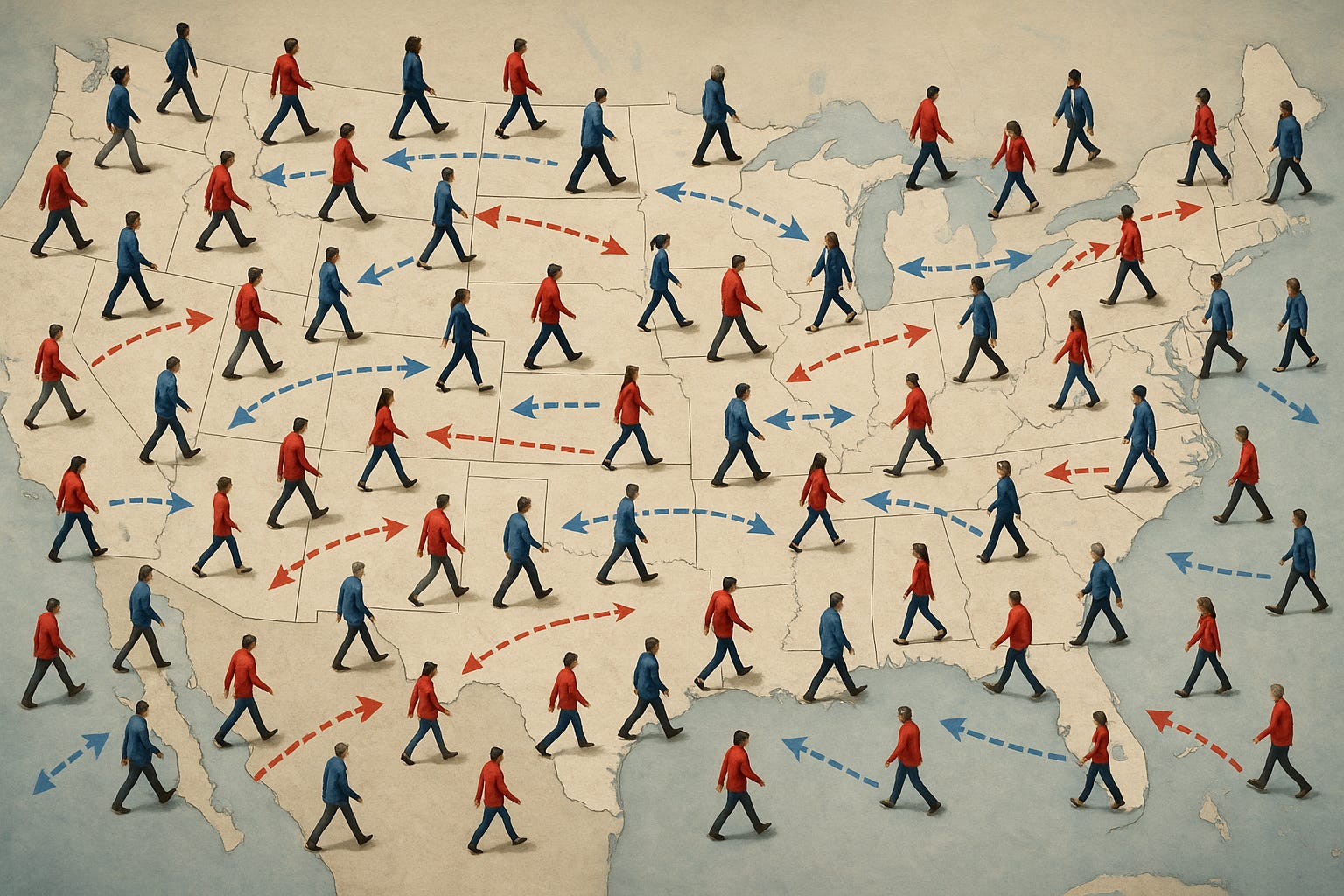
The latest political machinations involve red states’ attempts to redraw their congressional districts to give Republicans—assumed to be MAGA-Trumpist—more seats. They do that in two ways. First, they split up voters who tend to vote Democratic across multiple districts so that none has enough numbers to challenge a Republican majority; that’s called cracking. Second, they put as many Democratic-leaning voters as possible into a single district, leaving the other districts devoid of Democrats; that’s called packing. Democrats do it in reverse—though with more shame. Shamelessness is the Republican brand at the moment. As a side note, while I use the term “MAGA-Trumpist” to cover all Republicans, I hope the distinction between MAGA-Trumpists and real Republicans will matter again someday.
Everyone knows that this practice is known as “gerrymandering,” named for Elbridge Gerry. Gerry was not some small-town, two-bit politician. He was a signer of the Declaration of Independence and the Articles of Confederation—and was a delegate to the Constitutional Convention—but he refused to sign the Constitution because he disagreed with the strong federal power in it. He served in Congress and as governor of Massachusetts, where he redrew the state’s congressional districts to favor the Democratic-Republicans (the opponents of the Federalists at the time). That is where the term “gerrymander” comes from. The strongly Federalist voters in Massachusetts at the time hated that, and he lost reelection for governor in 1812. But the Democratic-Republicans loved him for it, and he became vice president under the second Democratic-Republican president, James Madison, a month after his loss in the governor’s race. He might have become president, but he died in 1814 on his way to Washington to preside over the Senate (one of the few constitutional duties of the vice president). While he was clearly a dedicated, if inconsistent, public servant, he will always be remembered for his “gerrymander” of 1812.
Which is to say that the “gerrymander” is deeply ingrained in American politics since the founding generation, of which Vice President Gerry was most definitely a part. Basically everyone used to do it once every 10 years in response to the constitutionally required decennial census (Article I, Section 2). Actually, that was just an excuse to redraw districts to lock in more power for whoever held it in the years after the decennial census.
In the case Rucho v. Common Cause, the Supreme Court confirmed what we already knew: there is nothing really illegal about partisan or political gerrymandering—it’s just a distasteful way to secure power. This was one of those cases where the Court basically said that if you don’t like the way partisans draw the lines, go complain to those partisans—the courts won’t help you. Underlying the decision is the understanding that gerrymandering is distasteful, of course, when your party loses power due to a gerrymander and a forgivable exercise of power when you benefit. Since there is nothing really at stake other than politics, the Court won’t wade into these disputes. It’s a “political question.”
Where gerrymandering remains illegal is when it’s used as a means to dilute minority voting power. It’s not in the Constitution explicitly. Actually, Article I, Section 2 contained the greatest racial gerrymander of all time: the clause counting only three of every five enslaved people for apportioning the House of Representatives and excluding Native Americans (“Indians not taxed”) from the census. The Fourteenth Amendment basically rewrote Article I, Section 2 after the Union imploded over how wildly unfair that method of apportionment was—and the fact that there were enslaved people in the first place who were not fully counted. To enforce the Fourteenth Amendment, after roughly 100 years of non-enforcement, Congress passed the Voting Rights Act of 1965—seen as the crown jewel of Civil Rights Era laws because it finally gave minorities the right to fair representation.
Section 5 of the Voting Rights Act required “preclearance” of any change in voting—down to the location of polling places—in “covered jurisdictions” with a history of discrimination, including many places in New York State. That was probably overkill. I remember when I was more involved in politics, we would often contest changes to polling places and voting rules we disagreed with as “illegal” under the Voting Rights Act. We cared about diluting minority voting power but, more often than not, we just wanted to win an election.
In 2013, in the case of Shelby County v. Holder, the Supreme Court struck down Section 5 “preclearance” and directed voters who felt their rights were being infringed based on race to file lawsuits under Section 2 of the Voting Rights Act. Now, in the 2025 case of Louisiana v. Callais, the Supreme Court is going to determine what it takes to win a Section 2 case—and most observers think they are going to make it very, very, very hard to challenge even blatantly racial gerrymanders. The impact is that we’re going to see fewer majority-minority districts.
In the absence of districts explicitly gerrymandered to the benefit of one race, most political observers think that means fewer safe Democratic districts, and they are probably right. Whether that means fewer minorities will be in Congress is an open issue. The fact that there is some link between one’s racial identity and one’s politics is turning out to be the great albatross of the Democratic Party. But there will certainly be fewer Democrats of any race in Congress. And from a legal perspective, there is nothing wrong with that—although, as a partisan Democrat, it sucks. To an extent.
In 2025 the Republicans just upped the ante—they’re in the midst of a partisan gerrymander without the excuse of the census. They are very legally gerrymandering the states they control for the sole purpose of creating more Republican districts in the middle of the decade (2026). Brilliant. Democrats will do the same in the states they control—and there are some biggies like California, New York, and Illinois. The unfortunate thing is that the largest Republican-controlled states—Texas and Florida—can essentially change the lines by Republican legislative fiat, while the largest Democratic-controlled states, New York and California, in a fit of “good-government” self-righteousness, took the power away from their Democratic legislatures and gave it to “non-partisan” redistricting commissions. It’s going to take some additional effort to redraw the lines in those states. California is pursuing a referendum on Election Day (Proposition 50) to redraw its lines for the 2026 elections with the explicit purpose of creating 5 additional Democratic-leaning districts. New York would not be able to redistrict until 2028 but hopefully will do the same.
In case it’s not clear, I regard partisan gerrymandering as both legal and necessary. I take it as a given that “red states” are going to redistrict their Democratic representatives out of office, and “blue states” are going to do the same to their Republican representatives—give or take a few packed districts. Certainly it stinks to live in a state where you feel your politics can’t get a fair shake. But Americans are mobile (or at least historically have been). If you don’t think your representatives share your values, move to a place where they do. We’re sorting by politics now.
The problem is that in the House of Representatives, representation follows population. But in many Democratic-leaning states, we refuse to create more housing. That is an economic problem—high housing costs that dissuade people from relocating—but it’s also a political problem because we live in an age of partisan (and probably racial) gerrymandering.
There is some history here. The Constitution does not set a limit on how many members the House of Representatives has—it just requires that there be no more than one representative for every 30,000 people. Before 1929, in response to the prior census, the House would reapportion itself by adding seats in places with fast-growing populations. As America became less agrarian and more industrial, those fast-growing places were cities. Since representation in the House was shifting quickly away from rural areas, the process broke down, and there was no reapportionment after the 1920 census—no seats were added and none were shifted—meaning the makeup of the House remained as it had been in 1910. While some rural areas might have benefited from keeping the apportionment the same, the stalemate led to the Permanent Apportionment Act of 1929, which capped the number of members of the House at the level it was in 1910: 435 members. It also established a formula to shift those seats around as population changes, taking reapportionment out of politics and making it purely a function of the census. The states then draw the lines based on the number of representatives that the formula provides.
Since we can’t add more seats, it’s a zero-sum game. When one place gains a seat, another loses one. Even if we could create more members of the House—as every Congress did before 1920—those seats would be created in faster-growing places. And sadly, those states that have the greatest population growth—and therefore will get more seats—are the ones where Republicans are going to crack and pack their Democratic voters. So the real risk is not the gerrymander. The real risk is a lack of population growth in those states that can be gerrymandered in the right way.
Keep thinking, keep building,
Jesse
Hi, and welcome to my newsletter! I’m Jesse Strauss, Your Fractional General Counsel. I’m a lawyer with a private practice based in New York City, helping clients in the United States and globally with their U.S. legal needs. My expertise spans various areas, including raising funding rounds, employment issues, negotiating master service agreements, intellectual property, compliance, legal process management, and dispute resolution. My focus is on founding and nurturing great companies from seed to exit. Discover more at Your Fractional GC and book a complimentary 30-minute consultation. You can also follow me on Threads @lawyerjesse1977, on BlueSky @lawyerjesse.bsky.social, subscribe to my Substack here (follow me on notes), and follow me on LinkedIn here.